A practical definition for manufacturing leaders — and the four-stage loop running inside every Dallas Roboter mobile robot.
For a decade, AI lived on a server. It recommended a product, approved a loan, drafted an email. It perceived and decided — but never acted. Physical AI is the step across that gap. It is intelligence that perceives a real environment, decides what to do, and executes motion in the physical world.
The difference matters because motion has consequences. A wrong word is a bad sentence. A wrong decision on a warehouse floor is a dropped pallet, a blocked aisle, a stopped line, or an injury. The physical world does not grade on a curve. It either works on the floor or it does not.
Perceive → Decide → Act → Learn. Then again, thousands of times a shift. Remove any stage and the loop breaks.
LiDAR, 3D vision, and time-of-flight sensors assemble a live model of the floor — walls, racking, pallets, people, obstructions. The picture is never complete. It is good enough to act on, and it updates continuously.
SLAM simultaneously maps and localises: the robot knows where it is and where it is going. Fleet intelligence schedules, routes, and negotiates traffic — up to 50 robots cooperating in one space, re-routing rather than waiting.
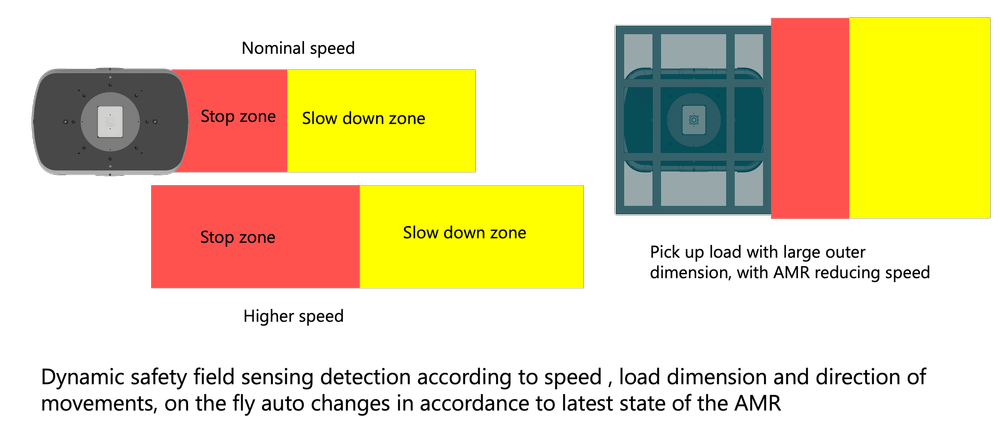
Safety-rated fields and precision motors convert decisions into motion, repeatable to ±10 mm at full load. This is where intelligence stops being abstract — and where the consequences are real.
Every task, route, dwell, and intervention is recorded. The data answers the operator's questions: where does the aisle congest at shift change, which transfer point needs a tag moved, which loop is near capacity. The floor teaches the system.
Simulation gets you 90% of the way. The last 10% is the building — the pallet that sits 40 mm off centre, the aisle where a stretch-wrapper blocks the scan, the loading dock that floods with sunlight at 4 p.m. and blinds a camera that worked all morning.
We map those edge cases during deployment, not before it, because they only appear when the robot is in your building, on your shifts, with your people. That is the difference between a demo and a deployment — and it is why we say physical AI in execution, not physical AI in principle.
An Automated Guided Vehicle follows a path that is installed into the floor.
An AMR reads its environment and navigates freely — no installed path at all.
A Dallas Roboter AMR does not "understand" your warehouse and it does not "think." It perceives, decides, acts, and reports — intelligent in the narrow, useful, verifiable sense: it can complete a task in a world it does not fully control. That is a deliberate choice. Bounded intelligence that ships beats unbounded intelligence that demos.
Labour, throughput, and floor space are all under pressure. Physical AI addresses all three: operators stop walking and start orchestrating, and material moves itself — on the floor you already have.
Vs manual transport, on the same floor.
Delivery to production cells.
On transport tasks in distribution.
One AMR costs less than two years of one forklift operator.
Physical AI acts at human scale, in human space — so safety constrains every decision the robot makes, from the first path plan to the final dock.

Line feeding, pallet transport, goods-to-person, stacking, heavy pallet, and end-to-end warehouse automation.
Explore ApplicationsPayloads from 60 kg to 1,500 kg. From light tote transport to 4.5 m counterbalance.
Browse the FleetAssess, simulate, deploy, optimise — 2–4 weeks from first conversation to operational AMRs.
Read the GuideBring us the loop that costs you most. Operational in 2–4 weeks. Supported 24/7 from DFW, Texas.
askme@dallasroboter.com · DFW, Texas · Engineering: Cyberjaya, Malaysia